CUET UG 2027: has it been announced? Dates, subjects, pattern and how admission works
As of 5 November 2026, NTA has announced nothing for CUET UG 2027. Here is what is known, how last cycle's pattern and fees looked, and how to choose subjects your target universities accept.
Edukrish Editorial Team
Written with AI assistance and fact-checked against official sources by the Edukrish editorial team.
Last checked against official sources.

2027 status checked 5 Nov 2026 · 2026 rules re-read in NTA's bulletin on 5 Nov 2026 · [How we check facts](/trust/how-we-check)
When is CUET UG 2027?
Quick answer
- CUET (UG) 2027 has not been announced yet. As of 5 Nov 2026, the National Testing Agency (NTA) has published no notification, dates or bulletin for it. NTA's exam calendar up to April 2027 lists CUET (PG) but not CUET (UG).[1][2]
- Last cycle (2026), for reference: applications ran 3–30 January 2026, and the exam was held in May with some days in early June.[3][4]
- What CUET is: a computer-based test.[3] A "paper" here means one subject test. In 2026 you could take up to five papers out of 37 subjects (13 languages, 23 domain subjects and a General Aptitude Test).[3] Each paper had 50 compulsory questions in one hour, marked +5 for a correct answer and −1 for a wrong one.[3][5]
- What decides your admission: each university's own rules, as well as your CUET score. NTA lets you take any subject.[5] Your target university decides which of your papers count. For 2026-27, the University of Delhi counted only papers in subjects you had passed in Class XII.[6]
- The biggest mistake is picking subjects before checking every programme you want.
- Nothing to apply for yet. Check cuet.nta.nic.in every week from December, and read the 2027 bulletin as soon as it appears.
Who is CUET UG 2027 for?
Nothing is announced for 2027. In 2026, NTA's bulletin said candidates who had passed Class 12 or an equivalent exam, or were appearing in 2026, could appear.[8] If NTA repeats that wording, CUET UG 2027 is for students who passed Class 12 earlier or are appearing in 2027. If you are in Class 12 now, 2027 is your cycle. If you are in Class 11 now, you finish Class 12 a year later, so your cycle is a year after that. That is our reading of the 2026 wording, not an NTA statement.
Status box: CUET UG 2027 (as of 5 Nov 2026)
| Item | Status | Source |
|---|---|---|
| CUET (UG) 2027 notification | Not yet announced | nta.ac.in and cuet.nta.nic.in, checked 5 Nov 2026[1] |
| 2027 application dates | Not yet announced | — |
| 2027 exam dates | Not yet announced. NTA's calendar to April 2027 lists CUET (PG), not CUET (UG)[2] | NTA's exam calendar (notice of 26 Oct 2026), read 5 Nov 2026 |
| 2027 Information Bulletin | Not yet published | — |
| Pattern, subjects, fees | Last cycle 2026 only. They may change for 2027 | NTA 2026 bulletin and FAQs[3][5] |
Official links: cuet.nta.nic.in · nta.ac.in · Edukrish CUET UG exam page, which shows dates as soon as NTA confirms them, with the date we last checked.
Key dates
| Stage | 2027 status (as of 5 Nov 2026) | Last cycle (2026), for reference only |
|---|---|---|
| Notification and application form | Not yet announced | Applications 3–30 Jan 2026; fee payment until 31 Jan 2026[3] |
| Exam dates | Not yet announced | Announced as 11–31 May 2026 (tentative)[3]; actually held 11–31 May and 6–7 June 2026 across 321 cities, including Dubai, Abu Dhabi and Sharjah, with 15,68,867 unique candidates registered[4] |
| Result (NTA scores) | Not yet announced | NTA result press release dated 23 June 2026[7] |
| University admissions (for example DU CSAS) | Not yet announced | DU CSAS(UG)-2026 Phase I opened 26 June 2026[6] |
The 2026 dates show you roughly how the cycle ran. They are no forecast for 2027. Plan your preparation around them, but do not book anything until NTA publishes the 2027 bulletin.
Who CUET UG is for, and which universities use it
CUET (UG) is the common entrance test for undergraduate admission at central universities and at other universities that choose to join. State, deemed and private universities can take part.
NTA does not publish a fixed number of participating universities. Its 2026 FAQs say the list "is dynamic" and is kept on the NTA website.[5] Sites that quote one exact figure are giving you a number you cannot check. Look at the current list on cuet.nta.nic.in, then check each university's own admissions page.
When CUET matters to you:
- You want a BA, BSc, BCom, BBA or similar programme at a central university such as the University of Delhi.
- You want a participating state or private university that accepts CUET scores.
When it may not:
- Engineering at the IITs and NITs uses JEE.
- Medicine (MBBS, BDS) uses NEET-UG.
- Many NLUs use CLAT; see our CLAT page.
Eligibility (last cycle 2026; confirm in the 2027 bulletin)
- Class 12 status: you could apply if you had passed Class 12 or an equivalent, or were appearing in it in 2026.[8] Students improving their marks chose "Passed" on the form.[5]
- Age: "there is no age limit for the candidates".[8] Ignore sites that say you must be 18.
- NTA's eligibility and the university's are separate. NTA says that taking CUET "does not entitle" you to admission.[8] Each university sets its own rules for every programme: Class 12 subjects, minimum marks, and which CUET papers it needs.
Before you apply, make sure you meet the rules of the programmes you want. NTA's bulletin puts that responsibility on the candidate.[8]
Choosing your subjects: the decision most students get wrong
There are two rules, and students often confuse them.
Rule 1, NTA's rule. You may choose CUET subjects "irrespective of the subjects opted in class XII".[8] In 2026 you could take up to five papers, counting languages and the General Aptitude Test.[5]
Rule 2, the university's rule. Each university decides which papers count for each programme. NTA's FAQs tell candidates to choose subjects "based on the eligibility criteria for a programme of a desired university".[5]
For 2026-27, the University of Delhi set two conditions:
- It counts only CUET Language and Domain papers in subjects you passed in Class XII, meaning the subjects you take and pass in your Class 12 board exams.[6]
- Each programme has its own subject combinations, published in DU's UG Bulletin of Information 2026-27.[6]
So under NTA's rule you may sit a Psychology paper without studying it in Class 12. Under DU's 2026-27 rule, that paper would not count for a DU programme.
How to read a university's combination rule (worked method)
In a university's rule, "List A" and "List B" are simply menus of papers. Each university defines its own lists, so read the definition in its bulletin (this explanation is ours, not NTA's or DU's). A "paper" is one subject test. Bulletins usually write combinations in this form: "one language from List A + subject X or subject Y + any two from List B". Read it in four steps:
- Fixed slots. Note any paper the programme names outright (for example, "Mathematics or Applied Mathematics"; this is an illustration, not a specific programme's rule).
- Choice slots. Note the lists you choose from ("any two from List B"). Check that you passed those subjects in Class 12, if the university requires that, as DU did for 2026-27.[6]
- Count the papers. Add up the papers the combination needs. For DU, add the language paper too. Compare the total with NTA's limit of five papers in 2026.[5]
- Repeat for every programme on your list, then combine them. Can one set of five papers satisfy them all? If not, you have a conflict and need to change either your programmes or your papers.
We have not printed DU's combinations; check them there. DU publishes them programme by programme in its UG Bulletin of Information 2026-27, and we have not read that bulletin. Go to DU's admission site, admission.uod.ac.in (the address DU's announcement names for updates) and copy your programme's rule word for word.
Example of a conflict (no university named; for illustration only). A student wants:
- Programme 1 needs a language, Mathematics and two List B subjects (4 papers).
- Programme 2 needs a language, Accountancy and two List B subjects (4 papers).
- Programme 3 at another university needs the General Aptitude Test (1 paper).
If the same language and the same two List B subjects work for both Programme 1 and Programme 2, the set is: language + Mathematics + Accountancy + 2 List B + General Aptitude Test = 6 papers. That is one more than the 2026 limit of five. The student must drop a programme or find an overlap, for example a combination where one subject fills two roles. Until you are sure, count by hand: list every programme's required papers, merge them, and check the total is five or fewer. (We're building a subject planner to do this check. It isn't available yet.)
Subject-planning checklist
- ☐ List every programme you would accept, at every university, not only your first choice.
- ☐ For each one, open the official university bulletin and copy its CUET combination rule word for word, with the page number.
- ☐ Check each subject against your Class 12 subjects if the university requires a match (DU did for 2026-27).[6]
- ☐ Check any minimum-score rule for language papers in the bulletin.
- ☐ Combine all the rules and count the papers. Stay within NTA's limit (five in 2026).[5]
- ☐ Include the General Aptitude Test only if a programme on your list needs it.
- ☐ Pick the language paper your programmes accept.
- ☐ Re-check everything when the 2027 NTA bulletin and the 2027-28 university bulletins are published, because rules can change each year.
Exam pattern (last cycle 2026)
| Feature | 2026 rule | Source |
|---|---|---|
| Mode | Computer-based test (CBT) | [3] |
| Subjects available | 37: 13 languages, 23 domain subjects, 1 General Aptitude Test | [5] |
| Papers you can take | Up to 5, including languages and the General Aptitude Test | [5] |
| Questions per paper | 50, all compulsory | [5] |
| Time per paper | 1 hour; PwBD candidates get 20 minutes extra per hour | [5] |
| Marking | +5 correct, −1 incorrect | [8] |
| Question-paper mediums | 13: English, Hindi, Assamese, Bengali, Gujarati, Kannada, Malayalam, Marathi, Odia, Punjabi, Tamil, Telugu, Urdu | [5][8] |
If you have a disability or medical need: the 2026 bulletin has a section on scribe and compensatory time (§4.3; compensatory time of 20 minutes for each hour for PwBD candidates). Read it, and the matching section of the 2027 bulletin, before you apply.[8]
The pattern can change between cycles, so use the 2027 bulletin once NTA publishes it.
Syllabus
NTA's 2026 FAQs say the domain papers are "benchmarked at the level of NCERT Syllabus".[5] The Class 12 NCERT textbooks for each subject are therefore your core material.
The 2026 bulletin sends you to a detailed subject-wise syllabus on NTA's own CUET site (cuet.nta.nic.in, "CUET (UG) 2026 syllabus").[8] Use syllabus files from that site, not copies on coaching sites, and look for the 2027 version when the cycle opens.
Step-by-step application (based on the 2026 process)
- Wait for the 2027 bulletin on cuet.nta.nic.in and read it fully.
- Finish your subject plan first (section above). You choose subjects on the form.
- Register with your own email and mobile number.
- Fill the form: personal details, Class 12 status ("Passed" if you are improving marks[5]), subjects, exam-city choices and question-paper medium.
- Upload documents. Documents held in DigiLocker can be uploaded.[5] Follow the bulletin's file-size and format rules exactly.
- Pay the fee. It depends on your category and the number of subjects (table below).
- Use the correction window if NTA opens one, and keep the confirmation page.
- Download the city slip, then the admit card, when NTA releases them.
Documents to keep ready, as the 2026 bulletin names them (confirm the final list in the 2027 bulletin; your university may ask for more, such as marksheets and category certificates):
- A recent photograph (the 2026 bulletin also asks for a live photograph at the time of applying)
- Your signature, as a scanned image
- A disability (UDID) certificate, if it applies
- Identity proof, if you verify your identity by a method other than Aadhaar or DigiLocker
- Your DigiLocker or Aadhaar details, if you use that route
On exam day (2026 rules):
- Report two hours before the start.
- Carry the printed admit card with its self-declaration, one passport photo (the same as uploaded) and an original photo ID.
- Mobiles, watches and metal items are not allowed.[8]
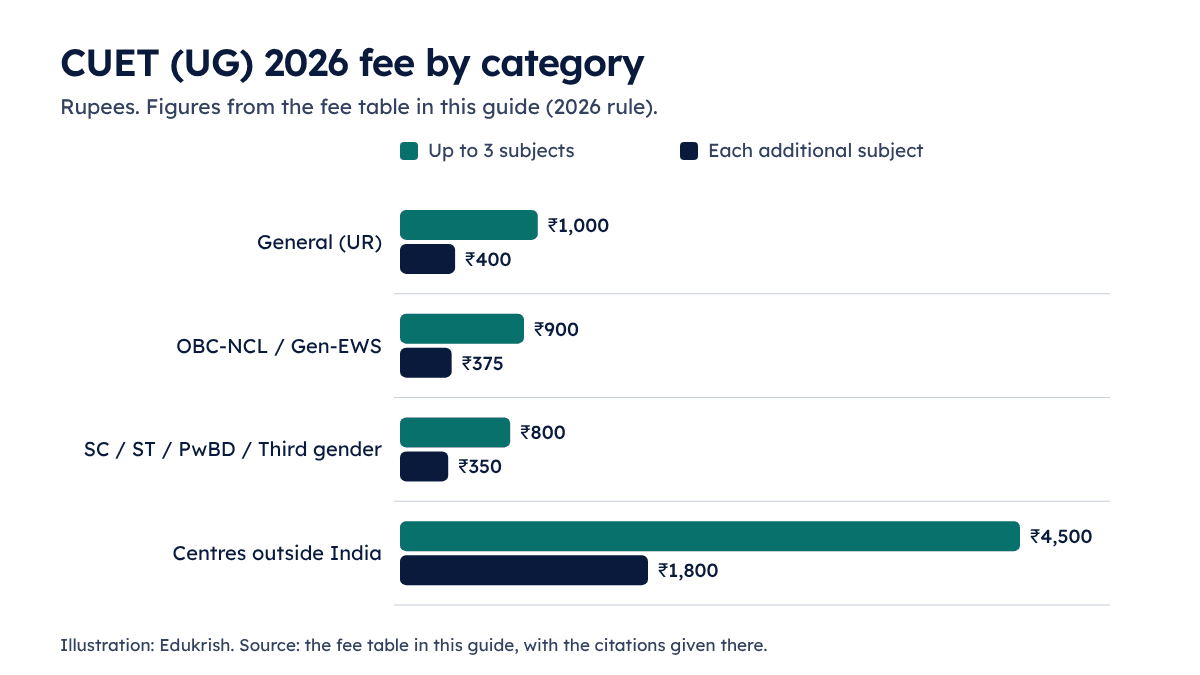
Application fee (last cycle 2026)[5]
(Worked total, from the table below: a General (UR) candidate with centres in India taking five papers paid ₹1,000 for up to three papers plus 2 × ₹400 for the extra two, which is ₹1,800. Check that the 2027 fee is the same before you rely on it.)
| Category | Up to 3 subjects | Each additional subject |
|---|---|---|
| General (UR) | ₹1,000 | ₹400 |
| OBC-NCL / Gen-EWS | ₹900 | ₹375 |
| SC / ST / PwBD / Third gender | ₹800 | ₹350 |
| Centres outside India | ₹4,500 | ₹1,800 |
After the result: how admission actually happens
NTA runs the exam and publishes your scores. In 2026 its result notice used the term "NTA Scores".[7] NTA does not allot seats.
Each university then runs its own admissions, using its own portal, eligibility rules and merit list. You must register separately with each university you want.
Example: University of Delhi, 2026-27 (last cycle).[6]
- Phase I: register on the CSAS(UG) portal (ugadmission.uod.ac.in) with your CUET application number. It opened on 26 June 2026. The one-time fee was ₹250 (UR/OBC-NCL/EWS) or ₹100 (SC/ST/PwBD).
- Phase II: match each CUET paper to the Class XII subject you passed. DU checks your eligibility for each programme and works out your score for each one. You then rank your preferred programmes and colleges.
- Allocation: DU says admissions to its programmes are "solely on the basis of the scores obtained in CUET (UG) - 2026", subject to programme-specific eligibility. Phase II dates were "to be announced shortly" in that notice.
- Scale: in 2026-27 this covered 73 programmes and more than 100 BA programme combinations, in 67 colleges.
Other universities run their own portals and timelines. We have not read the BHU or JNU pages for this article, so check each university's site. Bookmark each university's admissions page in May and check it weekly once results are near.
On "normalisation": subjects held in several shifts have different papers, so NTA converts raw marks into NTA scores using what its 2026 bulletin calls a "normalization procedure based on Percentile and Equi percentile method", worked out separately for each subject (Appendix VI).[8] The bulletin describes the steps with a worked example. Read that appendix in the 2027 bulletin, because NTA can change it.
Preparation timeline: November 2026 to the exam
There is no confirmed 2027 exam date. This plan assumes the 2027 cycle runs roughly like 2026: applications in January and the exam from May.[3][4] If NTA's dates differ, adjust it.
| When | Focus |
|---|---|
| Nov–Dec 2026 | List the programmes you would accept. Read their 2026-27 bulletins to see the kind of rules they use. Draft your five papers. Start NCERT Class 12 revision in your domain subjects alongside your board preparation. |
| Jan 2027 (if the 2026 pattern holds) | Read the 2027 bulletin as soon as it appears. Re-check your subject plan against it. Apply early; don't wait for the last day. |
| Feb–Mar 2027 | Board exams come first. Your CUET domain papers follow the NCERT syllabus, so board revision counts as CUET revision too. |
| Apr 2027 to exam | Timed practice: 50 questions in 60 minutes per paper, with −1 for wrong answers. Practise your language paper. Add the General Aptitude Test only if it is in your plan. |
| Result to admission | Register on each university's portal. Map your subjects carefully (DU Phase II). Enter all realistic preferences. |
Common mistakes
- Choosing subjects by "scoring potential" before checking university rules. A high score in a paper the programme doesn't count earns you nothing.
- Assuming "any subject" means "any subject counts". NTA allows any subject; DU 2026-27 counted only papers in subjects you passed in Class XII.[6][8]
- Planning for your first-choice programme only. Your backup programmes may need a different set of papers.
- Treating expected dates as real dates. Nothing for 2027 is confirmed yet.
- Forgetting the second registration. A CUET score alone gets you no seat; you must also apply on each university's portal.
- Guessing on the exam. Each wrong answer costs one mark.[8]
CUET vs JEE, NEET and board marks
| Test | What it is used for |
|---|---|
| CUET (UG) | Undergraduate admission at central and participating universities (BA, BSc, BCom and others), following each university's rules |
| JEE Main / Advanced | Engineering and architecture (NITs, IIITs, IITs and others) |
| NEET-UG | Medical and dental programmes (MBBS, BDS and others) |
| Class 12 board marks | Pass status and subject eligibility. Many universities also set minimum Class 12 marks for a programme, so check each university's bulletin. At DU in 2026-27, the merit list itself was based solely on CUET scores.[6] |
Next steps with Edukrish
- CUET UG exam page: official links, 2027 status and the date we last checked.
- All exams: JEE, NEET, CLAT and others, with official sources.
- Colleges explorer: look up universities and the courses they offer.
- Career library: see which degrees lead where. Examples: economist, psychologist, journalist.
- Free career interest assessment: not sure which programmes to aim for? Sign up and take the interest assessment first, then plan your CUET subjects around the careers that fit.
Spotted an error? Use "Report a problem" on this page or see our corrections log.
How we checked
Nearly every fact on this page comes from the National Testing Agency or from the official documents of a university (the DU notice was read in a copy hosted by a DU college). A few lines are marked as our own reading or explanation and are not tied to a document. We do not use coaching sites, news reports or forums as sources of fact. Each time-sensitive fact is labelled Confirmed for 2027, Last cycle 2026 or Not yet announced, with the date we checked it.
Frequently asked questions
- Has CUET UG 2027 been announced?
- No. As of 5 Nov 2026, NTA has published no notification, bulletin or dates for CUET (UG) 2027.[1][2] Our CUET UG exam page shows the status and the date we last checked.
- How many subjects can I choose in CUET?
- In 2026, up to five, counting languages and the General Aptitude Test.[5] Confirm this in the 2027 bulletin.
- Do I have to take subjects I studied in Class 12?
- NTA lets you choose any subject.[8] Universities decide which papers count. For 2026-27, DU counted only papers in subjects you had passed in Class XII.[6] Check each target university.
- Is there an age limit?
- Not in 2026: the bulletin said there was no age limit.[8]
- Is the General Aptitude Test compulsory?
- Not for everyone. It is one of the 37 subjects, and you need it only if a programme you want requires it.[5] Check the programme's bulletin.
- Does a good CUET score guarantee admission?
- No. NTA's bulletin says taking the test does not entitle you to admission.[8] Each university runs its own process and merit list.
- When will the CUET UG 2027 form come out?
- NTA hasn't said. The 2026 form ran from 3 to 30 January 2026, but that is no forecast for 2027.[3] Watch cuet.nta.nic.in and nta.ac.in.
- How is the CUET UG score calculated across shifts?
- Through NTA's percentile and equi-percentile normalisation, explained in Appendix VI of the bulletin.[8]
- How many students take CUET UG?
- In 2026, 15,68,867 unique candidates registered, according to NTA's press release.[4]
Sources
- NTA, nta.ac.in homepage notices and cuet.nta.nic.in notices (cuet site last updated 12 Oct 2026). Read 5 Nov 2026. https://nta.ac.in/ ; https://cuet.nta.nic.in/
- NTA, Examination Calendar, "December 2026 Cycle onwards" (notice of 26 Oct 2026). Read 5 Nov 2026. https://nta.ac.in/Download/Notice/Notice_20261026114247.pdf
- NTA, CUET (UG) 2026 Information Bulletin and FAQs (dates, mode). https://cdnbbsr.s3waas.gov.in/s3d1a21da7bca4abff8b0b61b87597de73/uploads/2026/01/202601031633478370.pdf · https://cdnbbsr.s3waas.gov.in/s3d1a21da7bca4abff8b0b61b87597de73/uploads/2026/01/2026011697237004.pdf
- NTA, press release on the conduct of CUET (UG) 2026. https://cdnbbsr.s3waas.gov.in/s3d1a21da7bca4abff8b0b61b87597de73/uploads/2026/06/20260608323708178.pdf
- NTA, CUET (UG) 2026 FAQs (Q2, Q3, Q6, Q7, Q17, Q19–Q24, Q27, Q28). Read 5 Nov 2026. https://cdnbbsr.s3waas.gov.in/s3d1a21da7bca4abff8b0b61b87597de73/uploads/2026/01/2026011697237004.pdf
- University of Delhi, Admission Branch, "Announcement of Admission to Undergraduate Programmes … 2026-27", 26 June 2026. Read 5 Nov 2026 in a copy hosted by a DU college: https://www.gargicollege.in/uploads/focus/Announcement_of_UG_Admissions_2026.pdf . DU's admission site, which the announcement names as its original source for updates: https://admission.uod.ac.in (we did not open it).
- NTA, "NTA Declares the Result/NTA Scores of Common University Entrance Test (UG) - 2026" (notice). https://nta.ac.in/Download/Notice/Notice_20260623135541.pdf
- NTA, CUET (UG) 2026 Information Bulletin (eligibility §3.1; scheme of examination §2.3, subject choice, marking, exam-day rules, §4.3 scribe and compensatory time, syllabus pointer, Appendix VI normalisation). https://cdnbbsr.s3waas.gov.in/s3d1a21da7bca4abff8b0b61b87597de73/uploads/2026/01/202601031633478370.pdf