Study in Germany after Class 12 from India: the Studienkolleg route, real costs and the visa
Whether you can go straight to a German bachelor's after Class 12, how the Studienkolleg route works, and what the blocked account (€11,904), APS, language levels and costs involve.
Edukrish Editorial Team
Written with AI assistance and fact-checked against official sources by the Edukrish editorial team.
Last checked against official sources.
Every figure was read on official pages on 4 and 5 November 2026. Several of those pages show no date, so check them again before you act. We update this page when they change.
Can I study in Germany after Class 12 in India?
Quick answer Germany's public universities charge little or no tuition, but with an Indian Class 12 certificate you generally cannot go straight into a bachelor's degree at a German university. DAAD India says so, with the exception of a valid JEE Advanced result. The usual route is a Studienkolleg, a preparatory course that usually takes two semesters and ends with the Feststellungsprüfung (FSP) exam. Another route is to complete a year of a bachelor's in India, which may allow subject-specific admission. Public universities charge no tuition for most bachelor's degrees, but you still pay a semester contribution and your living costs, and for the student visa you must show €11,904 for the first year in a blocked account. Most German-taught programmes need German at about B2 or above (the visa page says direct degree entry generally needs C1), and Indian applicants almost always need an APS certificate. Check the rule for your own certificate and course before you pay anyone.
Key takeaways
- DAAD India: "After a class 12 certificate … one cannot get a direct admission to a German university (the exception being a valid IIT-JEE Advanced result)" [1].
- A Studienkolleg "usually" takes two semesters. High performers may finish in one. Public Studienkollegs are free except for the semester fee [3].
- Public universities: "generally no fees for Bachelor's courses or most Master's courses". Baden-Württemberg charges non-EU students €1,500 per semester [5].
- The student visa needs a blocked account with €11,904 for the first year, no more than €992 withdrawable per month [6]. Check both figures on the day you apply.
- Indian school-leaving certificate holders "almost always require" an APS certificate [6].
- The winter-semester application phase usually runs from early May to 15 July. The summer semester runs from early December to 15 January [4].
Where things stand
| Item | Figure or rule | Page date | Source |
|---|---|---|---|
| Direct admission after Class 12 | Not possible, except valid JEE Advanced result | Not shown | [1] |
| Studienkolleg length | Usually two semesters | Not shown | [3] |
| Blocked account | €11,904; max €992 per month | 16 Feb 2026 | [6] |
| Proof of funds, DAAD | €992 per month "as of 1 January 2025" | Not shown | [5] |
| Living costs | €900–1,200 per month | Not shown | [5] |
| Student work allowance | 140 full or 280 half days per year; minimum wage €13.90 per hour since Jan 2026 | Not shown | [7] |
| Stay after graduating | Up to 18 months to look for work | Read 5 Nov 2026 | [8] |
Which route fits you?
| Where you are | What the sources say | Source |
|---|---|---|
| Class 12 certificate only | No direct admission. Complete a Studienkolleg and pass the FSP, then apply for a bachelor's | [1][3] |
| Valid JEE Advanced result | May apply directly for a subject-specific course | [1] |
| One year of a bachelor's in India done | "May allow" subject-specific admission. The DAAD overview mentions two or three semesters of comparable study at home | [1][2] |
| IB Diploma | DAAD India says an IB diploma is generally recognised as a school-leaving certificate and may allow direct general or subject-specific admission, depending on the subjects in the diploma | [1] |
| GCE (for example A levels) | "Can lead to a direct but strictly subject-specific" entrance qualification | [1] |
The uni-assist "check university admission" tool lets you pick your country and see how your certificate is rated. It says its results "serve as an orientation" and are not binding [9]. Use it, then confirm with the university you are applying to.
What a Studienkolleg is
A Studienkolleg is a preparatory course that builds "general, specialised and linguistic competencies" for study at a German university. It usually takes two semesters, and students who do very well may be able to finish in one [3].
- Subject tracks: at universities the tracks are M (medical, biological, pharmaceutical), W (business, economics, social sciences), G (humanities), T (mathematics, science, technical) and S (languages). At universities of applied sciences they are TI (technical), WW (economics), GD (creative) and SW (social sciences) [3]. You choose a track that matches the degree you want.
- The FSP: the Feststellungsprüfung is the final assessment. Passing it "allows access to studies throughout Germany" [3].
- Language: most Studienkollegs teach in German, and teach language skills up to C1 [3]. DAAD India gives about B1 to B2 for Studienkolleg, depending on the Studienkolleg [1]. For the visa, German missions in India ask for proof of at least B1 German if your preparatory course is taught in German, or B2 English if it is taught in English. If you go straight into a degree, they say the level is generally C1, whether the course is in German or English [6]. Universities and Studienkollegs set their own entry levels, so ask each one.
- Cost: public Studienkollegs are free of charge except for the semester fee. Private ones "frequently charge fees" [3].
- How to apply: for many public Studienkollegs you cannot always apply directly. Depending on the institution, you apply directly or through uni-assist [3]. Confirm that the university you want accepts the FSP from that Studienkolleg [3].
Language: German or English?
Most universities ask for German at least B2 on the European (CEFR) scale. For international or master's programmes taught in English, you show English proof instead [2]. DAAD India adds that German-taught programmes may need a higher level than B2 [1]. The visa page of German missions in India goes further: for direct entry into a degree, the level is generally C1, whether the course is in German or English [6]. If you want an English-taught bachelor's, DAAD's International Programmes database is the place to look; we have not checked individual programmes.
What it costs
All figures below are from DAAD and the Federal Foreign Office. The arithmetic is ours, shown so you can check it. We give euros only; exchange rates move and we have not used a rate source.
| Item | Amount | Source |
|---|---|---|
| Tuition, public university, bachelor's | Generally none | [5] |
| Tuition, Baden-Württemberg, non-EU students | €1,500 per semester | [5] |
| Semester contribution | €70–430 per semester (one example: €304.25, Cologne, winter 2024/25) | [5] |
| Living costs | €900–1,200 per month | [5] |
| Blocked account for visa | €11,904 for the first year (€992 × 12) | [6] |
| uni-assist assessment | €75 for the first course, €30 for each further course in the same semester | [4] |
| Private universities and private Studienkollegs | Set their own fees | [3][4] |
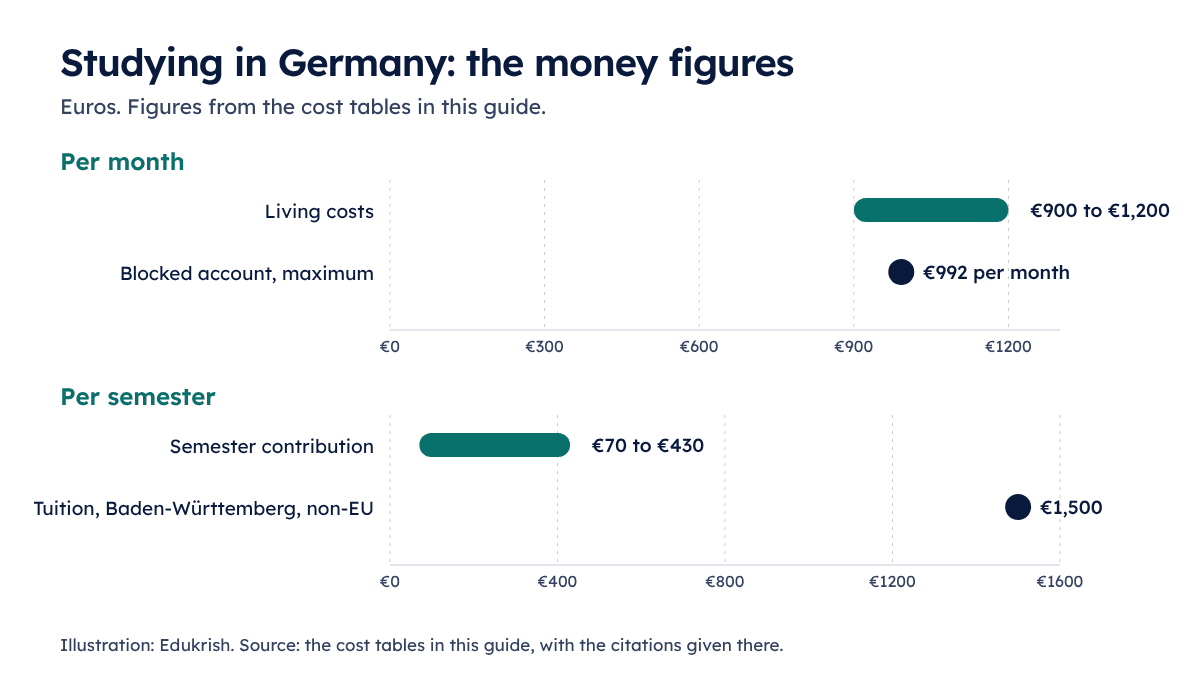
A rough annual living budget from DAAD's range is €10,800 to €14,400 (€900 or €1,200 × 12), before semester contributions and before any fee-charging institution. The blocked-account figure is a visa requirement and does not forecast what you will spend.
Other ways to show funds, German missions in India say, include a formal commitment by a sponsor, a German or EU scholarship, or an education loan [6]. If you plan to pay by loan, check with the visa authorities and your bank that your loan is accepted.
Working while you study
Students from outside the EU may work 140 full days or 280 half days a year. Minimum wage has been €13.90 per hour since January 2026 [7]. Treat this as help with costs and do not count on it to fund your visa. We have not checked whether this allowance applies in the same way during Studienkolleg.
The visa and APS
- APS: if you hold an Indian school-leaving certificate, you "almost always" need a certificate from the Akademische Prüfstelle (APS). DAAD India says to start the APS India procedure, which verifies Indian academic documents [1][6].
- Admission letter: German missions in India list an admission letter from a full-time degree programme at a German university, or an admission letter to a preparatory college, as proof of admission. Any remaining conditions, such as a language certificate, must be noted in the letter [6].
- Blocked account with €11,904 [6].
- Other documents: passport, school-leaving or degree certificates, language proof, motivation letter, CV and health insurance [6].
- Visa type: German missions in India say a German course not meant to prepare for university studies "is not the correct visa type" for a degree path [6].
- Processing time: the page gives none, so apply early and check the official visa page for the current appointment process.
The application calendar
- Winter semester (September/October): the application phase "begins in early May and ends on 15 July".
- Summer semester (March/April): early December to 15 January [4].
- Private universities may have different deadlines [4].
- Documents: you need officially certified copies of your entrance qualification and translations [4].
- Studienkolleg deadlines differ by institution and we have not collected them.
For a student finishing Class 12 in 2027, the first practical question is the Studienkolleg's own timeline, not the university's. Ask each Studienkolleg directly.
After the degree
The Make it in Germany portal says graduates can get a residence permit valid for up to 18 months to look for work. It advises booking an appointment with the foreigners authority before finishing your studies [8]. The page does not say whether work is allowed during the search.
Before you pay an agent or consultant
Many parents ask whether an agent is needed. The steps above are on public official pages, and the uni-assist fee schedule is published [4]. If you do use one, ask for a written list of what they charge and what they do, and compare it to the published fees. Ask whether any university or Studienkolleg pays them for referring you. We have not evaluated any agent.
For parents
- Plan the money in two phases: the preparatory year and the degree years. The blocked account shows only the visa minimum.
- Ask early about the certificate route, since the choice between Studienkolleg and one year of study in India changes the timeline.
- Keep a record of every document you upload and each official page you used. Rules and fees on these pages change.
What this guide does not cover
- Fees and deadlines of individual universities and Studienkollegs.
- Which Studienkollegs accept Indian applicants from which boards.
- English-taught bachelor's programmes.
- Scholarships.
- The UK and other countries (the Edukrish country pages have those).
- Master's programmes (the route is different).
Next steps with Edukrish
Edukrish is free during early access. These features are live now:
- Read the country page: Studying in Germany shows official figures for Indian students in Germany, tuition in Baden-Württemberg, the permit to look for work after graduating and the subjects Indian students choose, each linked to its source. See our Germany page for the visa and funds details we hold, each linked to its source, and check them against the sources in this guide.
- Browse the study abroad pages to compare Germany with other countries.
- Take the free interest and values assessment: sign up, then open the assessment before choosing a subject track.
- Explore careers in the career library, for example mechanical engineer or software engineer.
- Check scholarships: /scholarships.
How we checked
Methodology: we opened each source ourselves on 4 and 5 November 2026 and read the passages cited. We used only DAAD, the Federal Foreign Office, uni-assist and the Make it in Germany portal. We did not use consultancy, coaching or news summaries. Several sources show no date; we say so. The two proof-of-funds sources agree: €992 × 12 = €11,904.
Frequently asked questions
- Can I study in Germany after Class 12 in India?
- Yes, but usually not directly into a bachelor's. DAAD India says a Class 12 certificate does not give direct admission to a German university, except with a valid JEE Advanced result. The usual route is a Studienkolleg and the FSP [1][3].
- Is a bachelor's in Germany free?
- Public universities generally charge no tuition for bachelor's courses, but Baden-Württemberg charges non-EU students €1,500 per semester, and everyone pays a semester contribution [5].
- How much money do I need for the visa?
- €11,904 in a blocked account for the first year, with no more than €992 withdrawable per month [6]. Check both figures on the day you apply.
- Do I need German?
- DAAD says most universities ask for German at about B2 or above, and English-taught programmes need English proof instead [1][2]. For the visa, German missions in India say direct entry into a degree generally needs C1, whether the course is in German or English. The lower levels (B1 German or B2 English) are for preparatory courses [6]. Each university and Studienkolleg sets its own entry level, so ask them.
- What is APS?
- The Akademische Prüfstelle verifies Indian academic documents. German missions in India say holders of Indian school-leaving certificates "almost always" need its certificate [1][6].
- Can I work in Germany while studying?
- Yes, within 140 full days or 280 half days a year [7].
- Can I stay after graduating?
- Up to 18 months with a permit to look for work [8].
- Does passing the Studienkolleg guarantee a university seat?
- No. The FSP gives access to studies in general, but your course may have its own admission limits [2][3].
- How much does it cost to study in Germany after Class 12?
- Public bachelor's courses generally charge no tuition, except in Baden-Württemberg (€1,500 per semester for non-EU students). You still pay a semester contribution of about €70 to €430 and live on roughly €900 to €1,200 a month [5]. For the visa you must show €11,904 in a blocked account for the first year [6].
- Is IELTS enough, or do I need German?
- Most universities ask for German at about B2 or above, and English-taught programmes need English proof instead. The visa page says direct entry into a degree generally needs level C1, German or English. Each university sets its own level [1][2][6].
Sources
- DAAD India, Bachelor Studies. https://www.daad.in/en/study-research-in-germany/studying-in-germany/bachelor-studies/. Read 5 Nov 2026. No page date shown.
- DAAD, Requirements overview. https://www.daad.de/en/studying-in-germany/requirements/overview/. Read 5 Nov 2026. No page date shown.
- DAAD, Studienkollegs (preparatory courses) in Germany. https://www.daad.de/en/studying-in-germany/requirements/studienkollegs/. Read 5 Nov 2026. No page date shown.
- DAAD, Application process. https://www.daad.de/en/studying-in-germany/requirements/application-process/. Read 5 Nov 2026. No page date shown.
- DAAD, Costs of education and living. https://www.daad.de/en/studying-in-germany/living-in-germany/finances/. Read 5 Nov 2026. No page date shown; the €992 figure is stated as of 1 Jan 2025.
- Federal Foreign Office, German Missions in India, "Studies, including preparatory college and language courses for intended studies", dated 16.02.2026. https://india.diplo.de/in-en/service/2756350-2756350. Read 5 Nov 2026.
- DAAD, Side jobs. https://www.daad.de/en/studying-in-germany/work-career/side-jobs/. Read 5 Nov 2026. No page date shown.
- Make it in Germany, Stay in Germany after graduation. https://www.make-it-in-germany.com/en/staying-in-germany-after-studies. Read 5 Nov 2026. Page metadata date 2026-10-23.
- uni-assist, Check: university admission. https://www.uni-assist.de/en/tools/check-university-admission/. Read 5 Nov 2026.